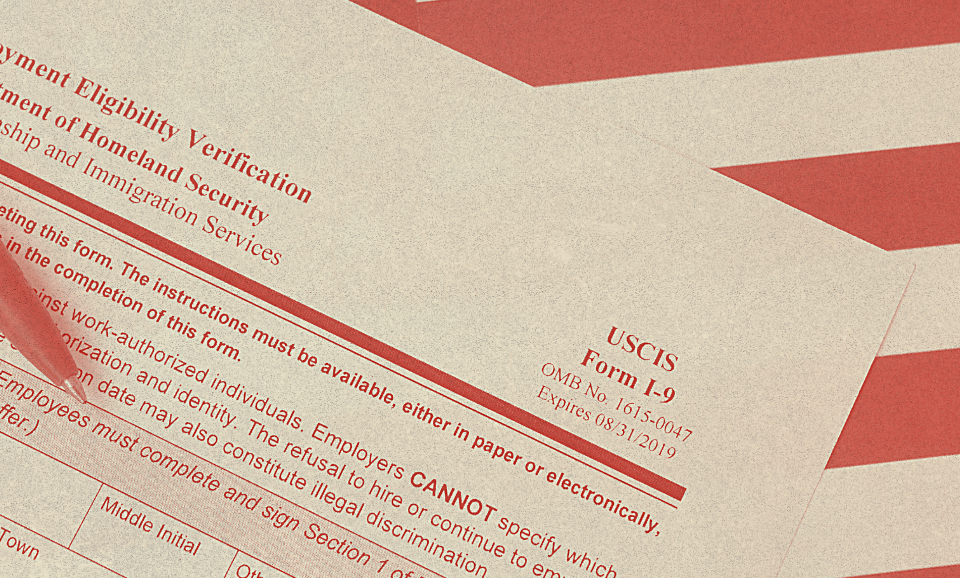
What Is Form I-9?
Form I-9 (Employment Eligibility Verification) is a federal form that every U.S. employer must complete for each employee hired after November 6, 1986. The form verifies two things: the employee’s identity and their authorization to work in the United States. It applies to every new hire regardless of citizenship or immigration status. U.S. citizens, permanent residents, and temporary visa holders all complete the same form.
The I-9 is not filed with any government agency. It is retained by the employer and must be available for inspection by USCIS, the Department of Labor, or ICE at any time. Failing to complete, retain, or produce the I-9 on demand exposes the employer to civil fines ranging from $252 to $2,507 per violation for first offenses, and up to $25,076 per violation for repeat or knowing violations.
In short
This guide covers everything employers and employees need to know about Form I-9: the three-section structure, acceptable documents (List A, B, and C), completion deadlines, reverification requirements, E-Verify, common employer mistakes, and how the I-9 process works for H-1B transfers, EAD holders, and other immigration-dependent employees.
The Three Sections of Form I-9
Section 1: Employee Information (Completed by Employee)
The employee must complete Section 1 no later than the first day of employment (not the first day of the offer, but the first day the employee begins work for pay). Section 1 includes:
- Full legal name, other names used, date of birth, address
- Citizenship or immigration status (U.S. citizen, noncitizen national, lawful permanent resident, or noncitizen authorized to work)
- If applicable: USCIS number, Form I-94 number, or foreign passport number
- Signature and date
The employee may use a preparer or translator to assist with Section 1, but the employee must still sign. The preparer/translator completes the Supplement A certification.
Section 2: Employer Review (Completed by Employer)
The employer must physically examine the employee’s original identity and work authorization documents and complete Section 2 within 3 business days of the employee’s first day of work. The employer records:
- Document title, issuing authority, document number, and expiration date
- The date employment began
- Employer’s name, business address, signature, and date
Critical
The employer must examine original documents. Photocopies are not acceptable (except for certified copies of birth certificates). The employer may not specify which documents the employee must present. The employee chooses from the acceptable document lists. Requiring a specific document (such as a Green Card or EAD) when other valid documents are offered constitutes document abuse, a form of immigration-related discrimination.
For a complete overview of the EAD and who needs one, see our guide on What Is an Employment Authorization Document.
Section 3: Reverification and Rehires (Completed by Employer)
Section 3 is used in two situations:
- Reverification: when an employee’s work authorization expires (for example, when an EAD or a visa-linked work authorization ends), the employer must reverify the employee’s continued eligibility before the expiration date. The employee presents a new document showing extended or renewed work authorization, and the employer records it in Section 3.
- Rehire: if a former employee is rehired within 3 years of the original I-9 date, the employer may complete Section 3 instead of a new I-9 (if the original I-9 is still valid and accessible).
Important
Employers must not reverify U.S. citizens, noncitizen nationals, or lawful permanent residents. Their work authorization does not expire. Reverification applies only to employees whose work authorization has an expiration date (EAD holders, H-1B workers whose visa period ends, OPT students, etc.).
Need help building an I-9 compliance system for your workforce?
A Grape Law attorney will review your current I-9 procedures, identify violations before an audit does, and set up a reverification calendar for your immigration-dependent employees. The initial assessment is free.
Book your free preliminary assessment →

Acceptable Documents
List A: Identity AND Work Authorization (one document from this list is sufficient)
- S. Passport or U.S. Passport Card
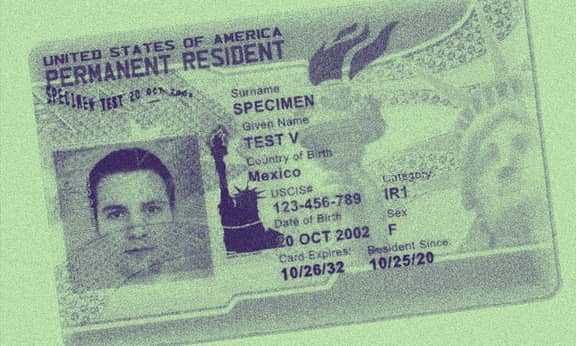
- Permanent Resident Card (Green Card, Form I-551)
- Foreign passport with Form I-94 and an endorsement authorizing work
- Employment Authorization Document (EAD, Form I-766)
- Foreign passport with Form I-551 stamp or MRIV
List B: Identity Only (must be combined with a List C document)
- S. driver’s license or state-issued ID with photo
- S. military card or draft record
- School ID card with photo (for minors)
- Voter registration card
List C: Work Authorization Only (must be combined with a List B document)
- Unrestricted Social Security card (not marked “NOT VALID FOR EMPLOYMENT”)
- Birth certificate issued by a U.S. state, territory, or possession
- S. Citizen ID Card (Form I-197)
- Employment authorization document issued by DHS
The employee presents either one List A document OR one List B document plus one List C document. The employer may not reject a document that reasonably appears to be genuine and relates to the person presenting it.
Form I-9 for Immigration-Dependent Employees
While the I-9 form is the same for everyone, the process has specific implications for employees whose work authorization is tied to their immigration status:
H-1B Workers
H-1B employees typically present a foreign passport with Form I-94 (List A) for the initial I-9. When the H-1B period expires and is extended, or when the employee transfers to a new employer, the employer must complete a new I-9 or reverify Section 3 with updated documentation. H-1B portability allows the employee to begin working for the new employer upon filing the transfer petition (Form I-129), even before USCIS approves it. The new employer should complete a new I-9 based on the employee’s existing valid documentation plus the I-129 receipt notice.
Expanding your business to the U.S. and hiring international employees?
Emily from Grape Law explains how multinational companies use the L-1 visa to transfer key employees to the United States, step by step.
Watch: L-1 Visa Explained: How to Expand Your Business to the U.S.
EAD Holders (OPT, H-4, L-2, I-485 Pending)
Employees with an Employment Authorization Document (EAD) present the EAD card (List A) for the I-9. EADs have expiration dates, and the employer must reverify before the card expires. If the employee has applied for EAD renewal (I-765) and the renewal is pending, automatic extensions may apply (typically 180 days from the expiration date for timely-filed renewals in certain categories). The employee should present the I-797C receipt notice together with the expired EAD as evidence of the automatic extension.
For the complete I-765 filing process and renewal timeline, see our EAD Application Guide.
Green Card Holders
Permanent residents present their Green Card (List A) for the I-9. Employers must not reverify permanent residents when their Green Card expires. The card’s expiration does not affect work authorization. Treating a Green Card holder’s expiring card as a trigger for reverification constitutes document abuse.
F-1 Students (OPT / STEM OPT)
F-1 students on OPT present their EAD (List A). STEM OPT extension holders present their new or updated EAD. Employers with STEM OPT employees must be enrolled in E-Verify and must report to USCIS if the employee’s employment is terminated.
Important
The I-9 form does not determine immigration status. It verifies work authorization. An employee may have valid work authorization even if their visa stamp has expired, as long as their I-94 status is current. Do not confuse visa stamp expiration with work authorization expiration.
For STEM OPT eligibility and employer obligations, see our STEM OPT Extension Guide.
E-Verify
E-Verify is an electronic system that compares Form I-9 information against government databases (Social Security Administration and DHS) to confirm employment eligibility. E-Verify is:
- Mandatory: for federal contractors, employers with certain state contracts (varies by state), and employers of STEM OPT students.
- Voluntary: for most other employers, though some states (Arizona, Mississippi, Alabama, South Carolina, and others) require it for all employers.
- Not a substitute for I-9: E-Verify supplements but does not replace the I-9 process. Even E-Verify employers must complete the paper (or electronic) I-9.
If E-Verify returns a Tentative Nonconfirmation (TNC), the employer must notify the employee and give them 8 federal business days to resolve the mismatch. The employer may not terminate or take adverse action against the employee during this period.
Common Employer Violations
- Late completion: Section 1 must be completed by the employee’s first day. Section 2 must be completed within 3 business days. Late completion is the most frequent violation found in audits.
- Accepting expired documents: the employer must verify that documents are unexpired at the time of examination (except for certain receipts with automatic extension rules).
- Specifying documents (document abuse): the employer may not tell the employee which document to present. Requiring a Green Card, EAD, or U.S. passport when other valid documents are available violates anti-discrimination provisions.
- Failing to reverify: when work authorization expires, the employer must reverify before the expiration date. Missing this deadline creates an unauthorized employment situation for the employer.
- Reverifying permanent residents: Green Card holders and U.S. citizens never need reverification. Reverifying them constitutes discrimination.
- Not retaining I-9 forms: forms must be retained for 3 years from the hire date or 1 year from the termination date, whichever is later. Destroyed or missing forms are treated as failures to complete.
- Photocopying documents selectively: if the employer copies documents for some employees, it must copy for all. Selective copying based on national origin or citizenship status is discriminatory.
Critical
ICE worksite enforcement audits (I-9 audits) can result in fines of $252 to $2,507 per I-9 violation for first offenses. Repeat or knowing violations can reach $25,076 per form. Pattern or practice of knowingly hiring unauthorized workers can result in criminal prosecution. A single audit covering hundreds of employees can produce six-figure penalties.
Employers facing H-1B compliance issues alongside I-9 obligations should also review our guide on H-1B Visa Denial: Common Reasons and Next Steps.
I-9 Retention and Storage
Employers must retain each I-9 for:
- 3 years from the date of hire, OR
- 1 year after the date of termination
whichever is later. Forms may be stored on paper, electronically, or on microfilm/microfiche. Electronic storage must include an audit trail showing all access and changes. Forms must be producible within 3 business days of a government inspection request.
Frequently Asked Questions
Does the employer file Form I-9 with the government?
No. The I-9 is retained by the employer, not submitted to any agency. It must be available for inspection by USCIS, DOL, or ICE upon request.
Can I complete the I-9 before the employee’s first day?
Section 1 may be completed after the employee accepts the offer but must be completed no later than the first day of work. Section 2 must be completed within 3 business days after the first day.
What if the employee presents a receipt instead of an actual document?
Receipts are acceptable for 90 days in three situations: a receipt for a replacement document (lost, stolen, or damaged), a receipt showing the employee has applied for an initial or renewal EAD (Form I-797C), and the arrival portion of Form I-94 with a temporary I-551 stamp. After 90 days, the employee must present the actual document.
My H-1B employee is transferring from another employer. Do I need a new I-9?
Yes. A new employer must complete a new I-9 for the transferring H-1B employee. The employee may begin working upon filing of the H-1B transfer petition (I-129 portability), but the I-9 must be completed based on the employee’s current valid documents within 3 business days.
My employee’s EAD expired but their renewal is pending. Can they keep working?
In many cases, yes. If the I-765 renewal was filed before the EAD expired and falls within an eligible category, an automatic extension of up to 180 days applies. The employee should present the I-797C receipt notice with the expired EAD. Record the automatic extension in Section 3.
Can I fire an employee if E-Verify returns a Tentative Nonconfirmation?
No. The employer must notify the employee of the TNC and give them 8 federal business days to resolve the mismatch by contacting the relevant agency. Taking adverse action (termination, suspension, reduction in hours) during this period violates E-Verify rules.
Do I need to reverify a Green Card holder when their card expires?
No. Permanent residents have indefinite work authorization. Reverifying them when their card expires is a form of document abuse and constitutes immigration-related discrimination. The same applies to U.S. citizens.
What happens during an I-9 audit?
ICE issues a Notice of Inspection (NOI) giving the employer 3 business days to produce all I-9 forms for current and recently terminated employees. ICE reviews each form for technical violations (missing fields, late completion) and substantive violations (unauthorized workers, document fraud). Fines are assessed per form. The employer may negotiate a settlement or contest the findings.
Facing an I-9 audit or hiring foreign workers for the first time?
Every employer’s situation is different. In a free preliminary assessment, a Grape Law attorney will review your I-9 obligations, E-Verify requirements, and any immigration-related compliance risks.
Book your free preliminary assessment →

Form I-9 is one of the most routine employment documents in the United States, and one of the most frequently violated. The rules are straightforward in principle: complete the form on time, accept valid documents without discrimination, reverify only when required, and retain the forms for the correct period. In practice, the process becomes complex when employees hold immigration-dependent work authorization that expires, renews, transfers between employers, or depends on pending USCIS adjudications. Getting the I-9 right protects your employees, protects your company from six-figure audit penalties, and prevents inadvertent discrimination claims. To review your I-9 compliance procedures and ensure your hiring process meets federal requirements, reach out to the Grape Law team at info@grapelaw.com.
Categories